We Just Filed at Supreme Court To Stop an Unconstitutional Power Grab in Virginia
Listen tothis article
The Virginia Constitution is not a suggestion – and the ACLJ is making sure the U.S. Supreme Court treats it as exactly what it is: the supreme law of the Commonwealth.
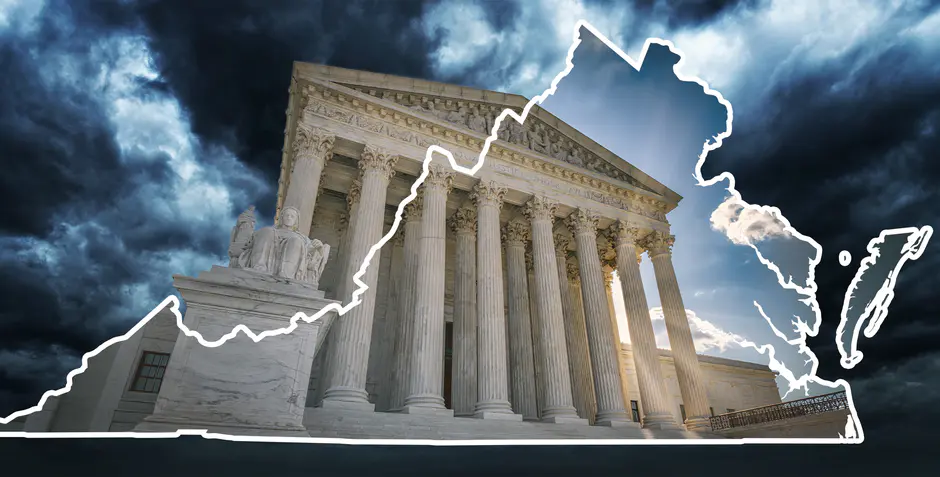
Today, the ACLJ filed an amicus brief at the United States Supreme Court in Don Scott v. Ryan T. McDougle opposing a last-minute request to stay the Virginia Supreme Court’s ruling that struck down a deeply flawed redistricting amendment. What is at stake is not merely a disputed map but whether the constitutional safeguards Virginians have relied upon for more than 150 years can be discarded in a partisan power grab by Virginia’s Leftist politicians.
The answer is no. And we are fighting to make sure it stays that way.
Earlier this year, the Virginia General Assembly rushed through a constitutional amendment – HJR 6007 and HB 1384 – that would have allowed the legislature to redraw Virginia’s congressional districts mid-decade, bypassing the bipartisan Virginia Redistricting Commission that Virginians themselves created by referendum just five years ago. The newly proposed map would have handed the Left-leaning voters 91% of Virginia’s congressional delegation while representing only 51% of the electorate – a ratio more skewed than California’s.
On May 8, the Virginia Supreme Court did exactly what courts are supposed to do: It held the line. It ruled that the legislative process behind this amendment violated Article XII, Section 1 of the Virginia Constitution, concluding that the “constitutional violation incurably taints the resulting referendum vote and nullifies its legal efficacy.” Now the applicants are rushing to the U.S. Supreme Court to seek a stay.
They are asking the U.S. Supreme Court to step in and overturn a Virginia Supreme Court decision interpreting the Virginia Constitution. But as we argued in our brief, this Court’s jurisdiction over state court decisions is limited to questions of federal law. The Virginia Supreme Court’s ruling rests on state constitutional text, state history, and state statutes. The fact that the court cited a few federal cases as persuasive authority while reaching its state-law conclusion does not transform it into a federal question. State courts cite federal precedents every day while resolving purely state-law issues. The adequate and independent state grounds doctrine bars the Supreme Court from intervening.
Take action with the ACLJ. Sign the petition: Defend Election Integrity and the Constitution.
Three Constitutional Violations – Any One Is Fatal
As we argued in our detailed legal analysis published earlier this month, the Virginia General Assembly did not make a minor procedural misstep. It committed three separate, independent violations of the Virginia Constitution – each one sufficient on its own to void the amendment entirely.
1) No Intervening Election. Virginia’s Constitution requires that a proposed amendment pass in one legislative session, then be referred to the General Assembly “at its first regular session held after the next general election.” (Emphasis added.) That language exists for a reason – it ensures the people have a say before their fundamental law is changed. Here, by the time lawmakers voted, over 1.3 million Virginians – roughly 40% of the total electorate – had already cast their ballots. As we have consistently argued in courtrooms across this country, including in our amicus brief in Bost v. Illinois, you cannot manipulate election timelines to serve partisan convenience. An election that is 40% complete has begun. There was no intervening election.
2)The 90-Day Requirement Was Ignored. Even setting aside the first defect, Virginia’s Constitution explicitly prohibits submitting a proposed amendment to voters “sooner than ninety days after final passage by the General Assembly.” HB 1384 received final passage on January 16, 2026. Early voting for the April referendum began on March 6 – just 49 days later. People were casting ballots on this amendment before the Constitution even permitted it to be placed before them.
3)The Ballot Language Was Deliberately Misleading. The amendment was placed before Virginia voters under the slogan “restore fairness.” But the amendment said nothing about fairness. It was a procedural authorization for mid-decade redistricting tied to the actions of other states. Worse, a voter reading only “restore fairness” had no way of knowing that a “yes” vote would effectively suspend the Virginia Redistricting Commission – a constitutional body the people of Virginia created by referendum. The ACLJ heard directly from its supporters in Virginia who were confused and had no idea what they were actually voting on. To prevent that is precisely why the Virginia Constitution’s submission requirements exist.
Our Fight For Election Integrity Goes Back Decades
The ACLJ has been at the forefront of election integrity for decades. In Beals v. Virginia Coalition for Immigration Rights, we filed an amicus brief at the Supreme Court defending Virginia’s constitutional authority to maintain accurate voter rolls and ensure only eligible citizens participate in elections. We appeared in Bush v. Gore, Trump v. Anderson, Republican National Committee v. Genser, and Bost v. Illinois State Board of Elections – consistently arguing that elections must be conducted according to the rule of law, and that constitutional safeguards are not optional. That principle does not change because one party finds those safeguards inconvenient.
Virginia has the oldest continuous tradition of written constitutional governance in the Western world. Its constitution sets strict guardrails for how it can be amended – and those guardrails are there to protect the people, not the politicians. When the General Assembly bypassed them, the Virginia Supreme Court did its duty. Now we are doing ours.
We are asking the Court to deny the stay and allow the Virginia Supreme Court’s ruling to stand. The integrity of Virginia’s constitutional order – and the votes of the more than one million Virginians who cast their ballots before this amendment could lawfully have been submitted – demands nothing less.
Sign our petition: Defend Election Integrity and the Constitution.