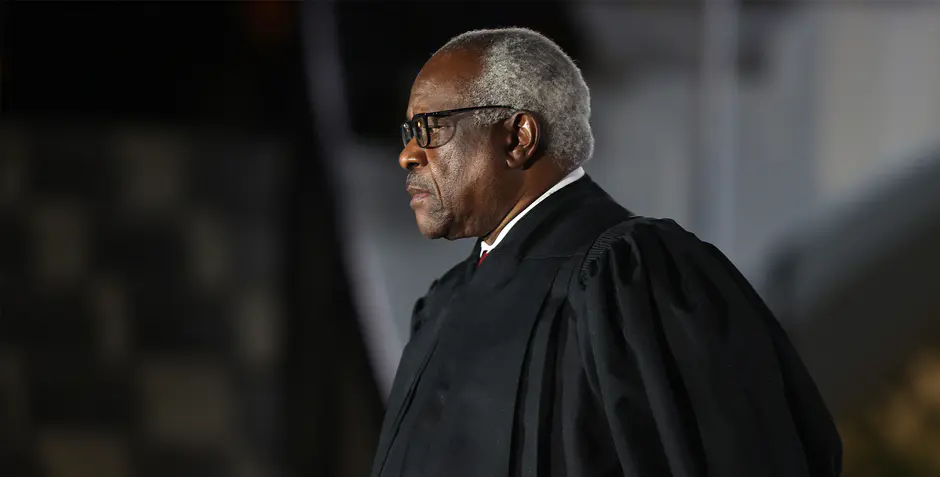
Justice Thomas Asks a Critical Question: Why Won’t the Supreme Court Protect Law-Abiding Americans?
Listen tothis article
Most Supreme Court dissents fade into obscurity. Every so often, however, a dissent transcends the case before the Court and raises a much larger question about the direction of our legal system.
Justice Clarence Thomas’ recent dissent in Whitton v. Dixon is one of those opinions.
Whitton itself was a death penalty case. The Court summarily vacated a lower-court decision based on what Justice Thomas called an “inconsequential foot fault.”
But Thomas’ dissent quickly moved beyond the facts of Whitton and confronted a troubling reality: The Supreme Court increasingly seems willing to intervene to correct minor or inconsequential errors to save guilty criminals while refusing to hear cases involving serious violations of the constitutional rights of ordinary Americans.
As Justice Thomas explained:
This Court routinely declines to provide relief to law-abiding Americans when it would actually matter, even after lower courts conspicuously flout this Court’s precedents in ruling against them.
That is a remarkable statement coming from a sitting Justice of the Supreme Court.
Take action with the ACLJ. Stand for freedom: Sign our petition.
Thomas’ concern is not simply that the Court occasionally declines review. The Supreme Court denies thousands of petitions every year. Rather, his criticism is that the Court is passing over cases involving obvious and consequential constitutional questions while expending its limited resources on matters that have little practical significance.
To illustrate the point, Thomas highlighted several recent examples.
First, he pointed to challenges to race-conscious admissions policies at elite public schools in Boston and Northern Virginia. In those cases, parents alleged that school officials deliberately manipulated admissions criteria at highly competitive schools. Despite evidence that policymakers were openly motivated by racial considerations, lower courts upheld the policies.
Thomas noted that the Court had “multiple opportunities to vindicate the rights of families to pursue education for their children on color-blind terms,” but nevertheless refused review. For families seeking equal treatment under the law, the Court’s silence was deafening.
Thomas next discussed the case of Air Force Staff Sergeant Cameron Beck, who was killed in a car accident caused by a negligent federal employee while Beck was returning home for lunch with his family. Beck’s widow sought relief under federal law but was denied by lower courts relying on a controversial judge-made doctrine that even members of the Court have acknowledged is difficult to justify.
According to Thomas, existing Supreme Court precedent should have compelled a different result. Yet the Court declined to hear the case, leaving Beck’s widow without a remedy.
Finally, Thomas pointed to cases involving campus speech codes and university bias-response teams. Across the country, students have challenged systems that encourage anonymous reporting of allegedly offensive speech and can subject students to investigations or referrals based on their expression.
Lower courts dismissed some of those challenges on standing grounds, effectively preventing students from ever obtaining a ruling on whether these policies violate the First Amendment.
Again, the Supreme Court declined review.
The common thread running through these cases is straightforward. They involve real constitutional injuries suffered by law-abiding Americans: parents seeking equal treatment, military families seeking justice, and students seeking to exercise their free-speech rights.
Yet the Court repeatedly passed on opportunities to address those claims.
That is why Thomas’ closing words are so striking.
“It is unfortunate,” he wrote, “that the Court chose to intervene at the request of a convicted murderer to correct the Eleventh Circuit’s inconsequential foot fault.”
Then he added:
What makes it even worse is that the Court does so even while it refuses to correct far more consequential errors for law-abiding citizens, such as the discriminated-against families in Boston, Staff Sergeant Beck’s widow, and the students seeking to challenge university censorship.
Whether one agrees with Thomas’ assessment of every case he identifies, the broader question he raises deserves serious attention.
The Supreme Court’s most important function is not simply correcting errors. It is ensuring that constitutional rights are protected and that lower courts faithfully follow the Constitution and the Court’s own precedents.
Justice Thomas’ dissent highlights an uncomfortable reality. Constitutional rights do not vindicate themselves. When courts refuse to hear important cases, the work of defending those rights falls to the citizens willing to stand up, the clients willing to fight, and the public interest attorneys willing to carry those battles forward.
Whether the issue is free speech, government censorship, religious liberty, equal protection, or parental rights, the ACLJ exists to ensure that Americans are not left without a voice when their constitutional freedoms are threatened. The cases Justice Thomas discussed reached the Supreme Court because someone was willing to challenge government overreach. Countless others never make it that far.
Justice Thomas’ dissent serves as a reminder that the defense of liberty requires persistence. When courts decline to act, organizations like the ACLJ must continue the fight. If you believe constitutional rights are worth defending, we invite you to stand with us. Your support enables the ACLJ to represent clients, challenge unconstitutional government action, and continue defending the freedoms that belong to every American.
Why won’t the Supreme Court protect law-abiding Americans? That is a question the Court should be prepared to answer.