DC Circuit Allows Sanctions Against Anti-Israel UN Official To Go Into Effect After “Consideration” of ACLJ Amicus Brief in Major Win for Presidential Authority
Listen tothis article
Today, the U.S. Court of Appeals for the D.C. Circuit handed down a significant victory for the rule of law, American sovereignty, and the President’s constitutional authority to defend our allies – and the ACLJ was right in the middle of it.
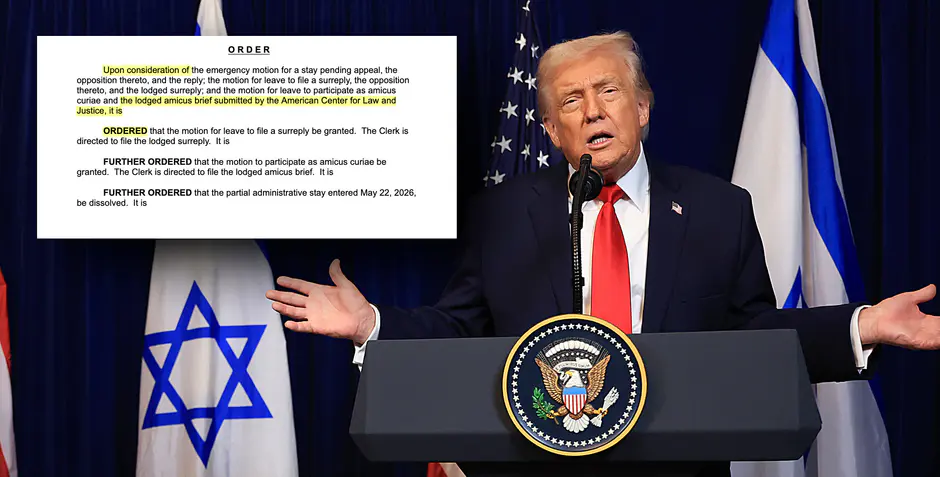
In Cali v. Trump, the D.C. Circuit granted the government’s emergency motion for a stay pending appeal, dissolving a lower court injunction that had blocked the Trump Administration from enforcing IEEPA-based sanctions against Francesca Albanese – the United Nations Special Rapporteur who repeatedly urged the International Criminal Court (ICC) to investigate, arrest, and prosecute Israeli officials and American citizens. The court specifically accepted the ACLJ’s amicus brief and considered our arguments in reaching this decision.
President Trump issued Executive Order 14203 to impose sanctions on foreign nationals who actively assisted the ICC’s illegitimate campaign to prosecute our close ally Israel – including sitting Prime Minister Benjamin Netanyahu. Albanese, an Italian citizen living in Tunisia, filed amicus briefs with the ICC itself, urging it to issue arrest warrants against Israeli officials, and submitted U.N. reports calling for the prosecution of American companies and executives. The Secretary of State designated her under the Executive order. A D.C. district court then blocked those sanctions, holding that the First Amendment likely protected Albanese’s conduct.
That ruling was wrong, and the D.C. Circuit has now said so.
In a powerful concurrence, Circuit Judge Katsas – joined by Circuit Judge Henderson – laid out the constitutional analysis with clarity: The First Amendment simply does not apply to the speech of non-resident aliens conducted abroad. As Judge Katsas explained, it is “long settled” that “foreign citizens outside U.S. territory do not possess rights under the U.S. Constitution.” An Italian citizen living in Tunisia, filing briefs in The Hague, cannot invoke the First Amendment to shield herself from lawful economic sanctions imposed by the President of the United States.
Judge Katsas also correctly recognized the profound national security and foreign policy stakes on the other side of the balance. The President was acting pursuant to both Congress’ express authorization under IEEPA and his independent Article II authority. Blocking that action inflicts irreparable harm on the government and the American people.
We did not sit on the sidelines. As we explained when we filed our brief – a federal district judge had overstepped badly, and the President’s constitutional authority to protect Israel and defend American citizens from ICC overreach was on the line. The D.C. Circuit agreed, ordering that “the motion to participate as amicus curiae be granted” and directing the Clerk to file “the lodged amicus brief submitted by the American Center for Law and Justice.” The court considered our arguments – and then stayed the injunction.
This fight is not over – the merits appeal lies ahead – but today’s ruling is a major step in the right direction. The ACLJ will continue standing with Israel, defending presidential authority, and fighting back against every attempt to weaponize international bodies against America and our allies.