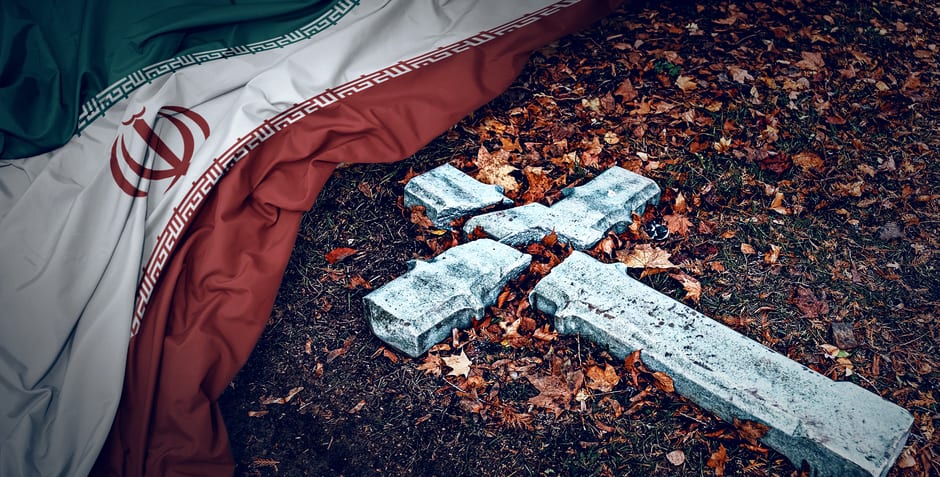
Iran’s Other War: The Regime’s Escalating Persecution of Christians
Listen tothis article
As the world’s attention remains fixed on the war with Iran, the ACLJ is working to ensure the regime’s persecution of Christians doesn’t get lost in the headlines. As part of that effort, we recently intervened at the U.N. to draw attention to the treatment of Iranian Christians.
As we wrote previously, we recently sent a letter to the U.N. Human Rights Council (HRC) regarding Iran’s seizure of a historically significant church. And earlier this week, we sent a report to the HRC detailing Iran’s treatment of Christians as well as reminding the HRC about the church seizure.
Iran is one of the world’s worst persecutors of Christians, ranking 10th among nations that systematically target believers – interrogating, detaining, torturing, imprisoning, and even killing them for their faith. The numbers are staggering. In 2025 alone, Iran arrested 254 Christians for their religious beliefs, and it killed at least 19 Christians following the anti-regime protests in 2026.
Iran especially targets Muslims who convert to Christianity, even keeping records of church membership and surveilling new members to determine whether they are converts.
Tragically, governments often exploit wartime conditions to justify the erosion of liberties, especially religious freedom. As we pointed out in our report:
[L]ast year, when Iran arrested over 50 evangelical Christians, officials stated that they had “neutralized” them. Obviously, conflict enables states to impose emergency regulations, which too often lead to consolidated authority, limited assembly rights, monitored and/or suppressed religious communities, and the labeling of minority faiths as “national security threats.” History shows that these regulations, although initially deemed temporary necessities, continue on long after the conflict ends.
Violations like these have played out once again in Iran over the past few months.
Our report details several examples:
- In July of 2026, the Iranian regime shut down 150-year-old St. Peter Evangelical Church, the oldest Protestant Church in Iran.
- On June 4, 2026, the Evangelical Church of Mashhad was bulldozed by workmen under orders from Iran’s regime.
- In March 2026, Christian convert Mohammad Nikbakht “was violently arrested at his home.” He was verbally threatened twice with charges that carry the death penalty. As of late June, he was being held in the political prisoners’ ward.
- On July 14, 2026, Iran’s Ministry of Intelligence blacklisted all Christian satellite broadcasters as “hostile” organizations and prohibited any form of “cooperation” with them, including simply watching them. At least five Christians have already been prosecuted under these new restrictions.
Even before Iran imposed these new regulations, Christian evangelism was heavily suppressed.
In May 2026, Iranian authorities detained three members of a “‘Christian evangelistic network’ that had converted friends and family to ‘Zionist’ Christianity, and ‘prayed for the victory of the Zionist regime.’” A month earlier, an Iranian house church leader, who had a Muslim background, was interrogated, detained, and abused for his ministry.
Given the gravity of these abuses, we requested that the HRC address Iran’s systematic repression of religious freedom. Specifically, we requested that the HRC address the following:
[T]he shutting down of churches, confiscation of church properties, and detention, interrogations, and imprisonment of Christians in its resolutions and its mandate to the Independent Fact-Finding Mission on the Islamic Republic of Iran. Finally, we request[ed] that the [HRC] ask the Iranian government to return St. Peter Evangelical Church to its rightful owner, the Council of the Evangelical Churches of Iran.
Each year, the ACLJ files numerous reports with various U.N. bodies addressing human rights violations around the world. Through our international affiliate, the European Centre for Law and Justice (ECLJ), and its special consultative status with the U.N., we have a significant platform to respond to the ongoing persecution of Christians globally.
Iran remains one of the most urgent cases, given its systematic assault on religious freedom, and the ACLJ and ECLJ remain committed to standing with Iranian Christians against these atrocities.
Take action with us as we continue this critical work. Sign our petition: Stop the Slaughter and Torture of Christians in Iran.